Whether you're renting a dump trailer for a landscaping project in Eagle Mountain, hauling equipment across Utah County, or moving across Saratoga Springs in an enclosed trailer — you need to know Utah's towing laws before you pull out of the driveway. This guide covers everything: weight limits, brake requirements, lighting, hitch classes, and licensing.
Quick Reference: Utah Towing at a Glance
1. Utah Trailer Weight Limits
Utah Code § 41-1a governs trailer registration and weight. The key numbers for everyday trailer users:
- Single axle max: 20,000 lbs gross axle weight
- Tandem axle max: 34,000 lbs gross axle weight
- Maximum gross vehicle weight: 80,000 lbs on most Utah highways
- Trailer registration threshold: All trailers over 750 lbs empty weight must be registered in Utah
For practical purposes: if you're renting a utility trailer, enclosed trailer, dump trailer, or car hauler, you're well within these limits as long as you don't overload the trailer's rated capacity.
Our Trailer Capacities vs. Utah Limits
2. Trailer Brake Requirements in Utah
This is the rule that surprises most Utah drivers, because there isn't one simple weight at which Utah law requires trailer brakes. Here's what applies:
- Every truck and trailer: Utah Code § 41-6a-1623 says your tow vehicle and trailer together must be able to stop within 40 feet from 20 mph on dry, level pavement, and have a parking brake that holds on any grade you drive. There's no weight cutoff.
- The 3,000-lb rule: Federal brake standards (49 CFR 393.42) require brakes on all wheels of a trailer unless it weighs 3,000 lbs or less AND no more than 40% of what your tow vehicle weighs on its axles. Utah applies these standards to commercial vehicles and lists them as its braking standards (Utah Admin. Code R714-300), but no Utah law or guidance clearly says whether they cover private towing, and the Utah Driver Handbook tells drivers to ask the Utah Highway Patrol. To be safe, plan on working trailer brakes and a brake controller if your loaded trailer is over 3,000 lbs or heavy compared to your tow vehicle.
- Breakaway brakes: Utah law has no 1,500-lb breakaway rule. Under the same federal standards (49 CFR 393.43), any trailer that's required to have brakes also needs a breakaway system. If the trailer comes loose, that system puts the trailer's brakes on by itself and keeps them on for at least 15 minutes. Those standards are written for commercial vehicles, so how they apply to private towing isn't settled. If your trailer has a breakaway cable, clip it to your tow vehicle, not to the hitch or safety chains.
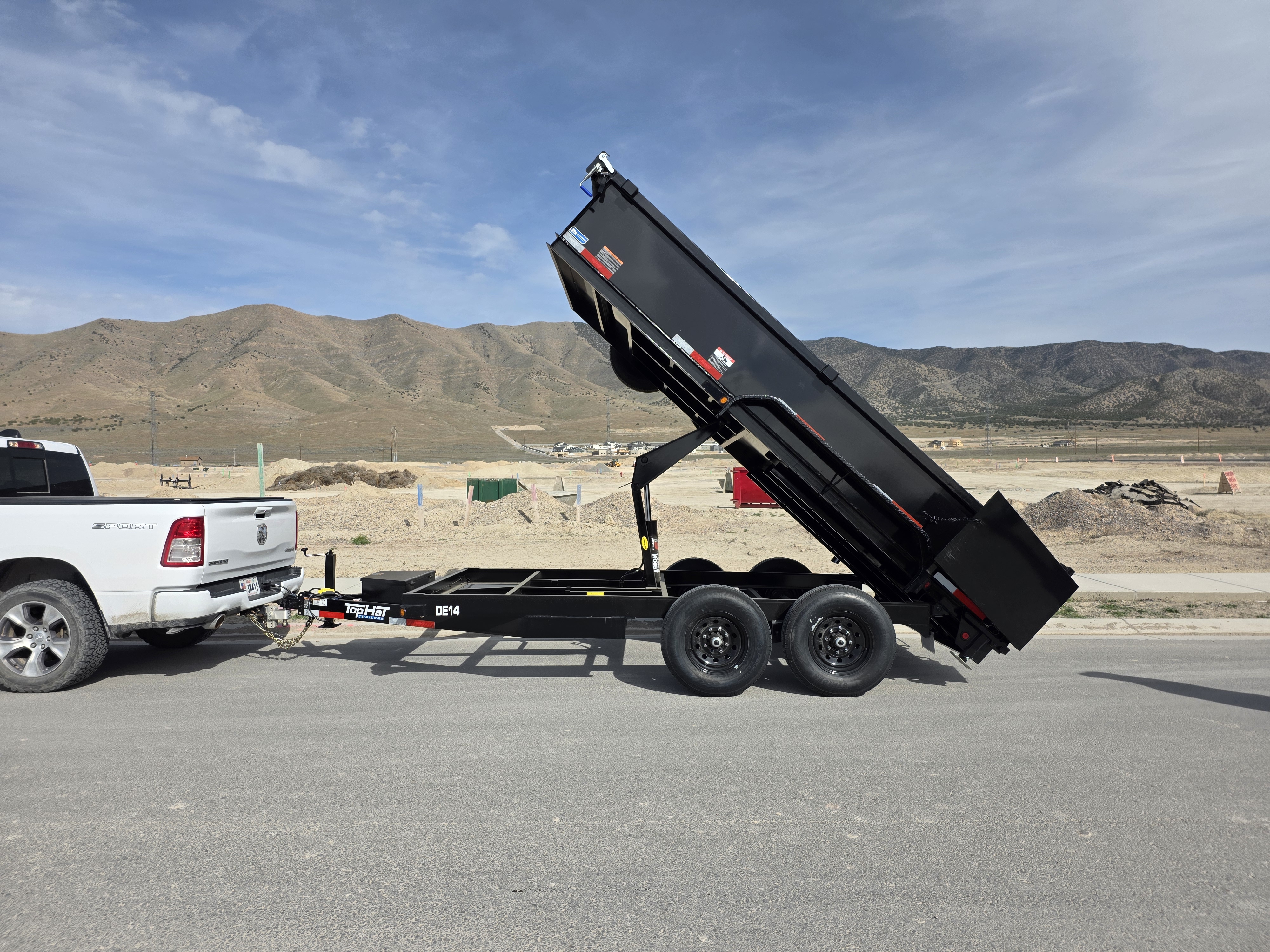
What this means in practice: Our dump trailer, enclosed trailer, and car hauler are all equipped with electric trailer brakes. You'll need a brake controller installed in your tow vehicle to tow any of them. If your truck or SUV doesn't have one, get a plug-in or integrated brake controller before you tow.
Our utility trailer (7×14, single axle) doesn't need a brake controller. Still, match your load to your tow vehicle: a loaded trailer that's heavy compared to what's pulling it is harder to stop, and Utah requires every truck and trailer to be able to stop within 40 feet from 20 mph.
Check Your Brake Controller Before You Book
Our dump trailer, enclosed trailer, and car hauler have electric brakes, so your tow vehicle needs a brake controller. Not sure yours has one? Call or text us 24/7, or check availability online.
3. Licensing Requirements
Utah doesn't require a special license to tow a trailer with a standard pickup or SUV unless your setup meets both Class A CDL limits below. For most truck and trailer combinations:
- Standard Class D license: Enough for our utility trailer, enclosed trailer, and car hauler with a personal pickup or SUV, since none of them is rated over 10,000 lbs. Our dump trailer is rated 14,000 lbs GVWR, so also check your truck's GVWR on the sticker in the driver's door jamb. At 12,000 lbs or less, the pair stays under the 26,001-lb Class A line.
- Class A CDL required: Only when your truck and trailer together are rated 26,001 lbs or more (combined GVWR) AND the trailer alone is rated over 10,000 lbs GVWR. Meeting just one of those doesn't trigger it. The rule clearly applies if you tow for work or a business. Towing a camper or RV purely for personal recreation doesn't need a CDL. For other personal towing at those weights, check with the Utah Driver License Division before you drive.
- Class B CDL: Single vehicles over 26,001 lbs GVWR without a trailer
Bottom line: behind a pickup or SUV, our utility trailer, enclosed trailer, and car hauler are fine on a standard Utah driver's license. For the dump trailer, check your truck's GVWR first. At 12,000 lbs or less, you're fine. Above that, towing it for work or a business takes a Class A CDL, and for personal use, ask the Utah Driver License Division before you tow.
4. Lighting Requirements
Utah requires all trailers operating on public roads to have:
- Tail lights (red, visible from 500 ft)
- Brake lights
- Turn signals
- Clearance lights on trailers wider than 80 inches
- Reflectors on each side and rear
- License plate light
All of our trailers have proper lighting and a 4-flat or 7-pin connector. Make sure your tow vehicle's trailer wiring harness is in good working order before departure. If lights aren't working, you can be cited under Utah Code § 41-6a-1603.
5. Hitch and Safety Chain Requirements
Utah law requires:
- Safety chains: Two safety chains or cables crossing under the tongue of the trailer, capable of supporting the trailer's gross weight. This is non-negotiable — you will be cited without them.
- Hitch class matching: The hitch receiver must be rated for the weight you're towing. Don't exceed your hitch's rated capacity.
- Ball size matching: Mismatched ball sizes are a common cause of accidents. Our trailers use 2-5/16" balls for the dump, enclosed, and car hauler, and 2" for the utility.
When you pick up our trailers, verify the safety chains are properly attached — they should cross under the trailer tongue in an X pattern.
6. Maximum Trailer Dimensions
- Length: Single trailer max 40 ft; vehicle + single trailer max 65 ft
- Width: Max 102 inches (8.5 ft) without a permit
- Height: Max 14 ft without a permit
Our 24ft enclosed trailer and 22ft car hauler are both 8'6" wide — right at the limit, so be mindful on narrow roads. The dump trailer and utility trailer are both 7' wide, within normal limits.
7. Speed Limits When Towing
Utah doesn't impose a blanket lower speed limit for vehicles towing trailers, but:
- You must always drive at a safe speed for conditions. Trailer sway becomes dangerous above 55 mph if not properly loaded.
- Most truck stops, campgrounds, and residential areas post lower limits that apply when towing.
- Interstate towing in Utah: follow posted speed limits, typically 75–80 mph. However, professional drivers recommend keeping loaded trailers under 60–65 mph for stability.
8. Registration & Insurance
Rental trailers (like ours) are registered and carry commercial liability insurance. When you rent from us, you don't need to separately register or insure the trailer. However:
- Your personal auto insurance may or may not cover damage to a rented trailer. Check with your insurer before your rental date.
- If you own a trailer, it must be registered with the Utah DMV. Registration fees vary by weight.
Common Utah Towing Violations to Avoid
- No safety chains — most commonly cited violation
- Trailer lights not connected or not working
- Overloaded trailer (exceeding rated capacity)
- A truck and trailer that can't stop within 40 feet from 20 mph, such as a heavy trailer with no working brakes
- Improper hitch ball size
- Trailer exceeding width limits without a permit