
Most trailer accidents aren't caused by bad driving. They're caused by a bad load — too much weight in the wrong place, a strap that wasn't tight enough, or something that shifted on the first hard brake. Loading a trailer right takes maybe ten extra minutes, and it's the difference between an uneventful trip and a very bad day on I-15.
We rent dump trailers, enclosed trailers, utility trailers, and a car hauler out of Eagle Mountain, and we've seen people come back with bent ramps, blown tires, and some interesting stories. Almost all of it was preventable. Here's what we tell renters before they drive off.
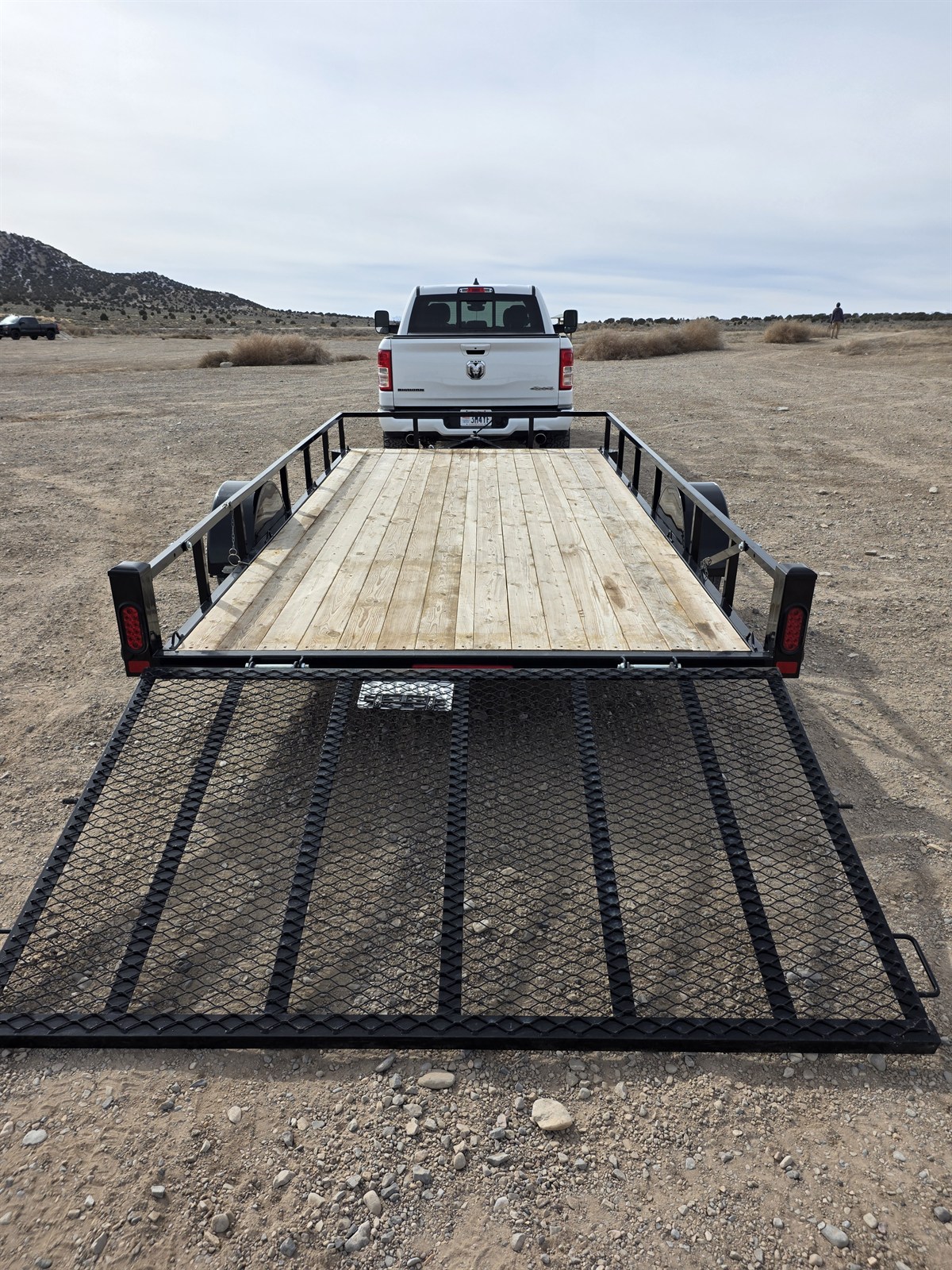
Start with Weight Distribution
This is the one that matters most, and it's the one people get wrong most often. The rule is simple: 60% of your load's weight goes in the front half of the trailer, ahead of the axles. The rear 40% fills in behind.
Why? Because this creates positive tongue weight — the downward force the trailer puts on your hitch. Tongue weight should be roughly 10–15% of the trailer's total loaded weight. When it drops below that (because you put too much weight in the back), the trailer gets light at the front and starts to pendulum. That's trailer sway, and at highway speed on I-15 it's genuinely terrifying.
Heavy items go low and forward: rocks, soil, appliances, toolboxes, engine blocks. Lighter items — boxes, bags, gear — fill in around and above them. If you're loading a dump trailer with landscaping rock, spread it evenly rather than dumping it all in the back where it's easiest to shovel.
Tie-Downs: Use Ratchet Straps, Not Bungees
Bungee cords are fine for keeping a tarp down. They are not tie-downs. A ratchet strap anchored properly to your trailer's D-rings or stake pockets will hold your load; a bungee cord just bounces with it.
A few things to know about using straps correctly:
- Cross them diagonally. Two straps running straight over a load can let it slide forward or backward. Crossing them limits movement in all four directions.
- Anchor to the trailer, not the load. Wrap the strap around or through the item and hook to the trailer's tie-down rings. If you hook strap-to-strap or to something attached to the load, you've just made one big item that can all move together.
- Check tightness after the first mile. Everything settles. Stop down the road and re-crank your straps — especially on the first haul.
- For open trailers, add a cargo net. Lightweight debris, bags, and loose items need a net over the top. A cardboard box at 65 mph is a serious hazard to the car behind you, and Utah law holds you liable for anything that falls off your trailer.
Tongue Weight: How to Know if You're in the Zone
You don't need a scale at the hitch to estimate tongue weight. Here's a quick field method: with the loaded trailer hitched and level, unhitch it and rest the coupler on a bathroom scale. The reading should be 10–15% of the trailer's total loaded weight.
Too heavy on the tongue? Move some weight back, but don't go past the 40% mark in the rear. Too light? Move weight forward. If you can't move the weight — say you're towing one large piece of equipment — at least know what you're dealing with so you can adjust your driving: slower speeds, wider following distance, easy braking.
Before You Pull Out: The Five-Minute Check
Every time, before you move. It takes five minutes and it catches the things you forgot:
- Hitch is fully locked. The coupler latch is down and the pin or clip is in. Give the trailer a hard upward pull to confirm it won't come off.
- Safety chains are crossed under the coupler. Crossed chains form a cradle that catches the coupler if it separates from the ball. Straight chains just let the trailer drop to the road.
- Lights work. Have someone stand behind the trailer while you hit the brakes, turn signals, and running lights. A trailer with no brake lights is a rear-end waiting to happen.
- Tires are inflated. Check the trailer tires, not just your truck tires. Trailer tires often run at higher pressures than tow vehicle tires — check the sidewall. An underinflated trailer tire at highway speed generates heat and fails fast.
- Load is still secure. Give your straps a final check. If you're towing an enclosed trailer, make sure the rear doors are latched.
Driving With a Trailer: What Changes
You already know trailers don't brake as fast or turn as tight. A few things people forget:
- Give yourself triple the following distance. The trailer's weight is pushing you forward when you brake. You need the extra room.
- Make wide turns. The trailer's wheels cut inside your truck's path. On right turns especially, swing wide or you'll clip curbs and signs.
- Check your mirrors often. If the trailer starts to sway, you'll see it before you feel it. Ease off the gas — do not hit the brakes — and let the rig slow down naturally.
- Lower your speed on canyon roads. Utah's mountain passes put load on trailer brakes and tires. If your trailer has electric brakes, test them before you hit a grade.
Dump Trailer Specifics
A few things unique to dump trailers that catch first-timers off guard:
- Never dump on a slope. Hydraulic dump trailers can tip sideways if the ground isn't level. Find flat ground at the landfill before you raise the bed.
- Clear behind the trailer before dumping. The bed swings up — anything behind it gets crushed or buried. Walk the area first.
- Don't overload wet material. Saturated soil and gravel weigh significantly more than dry. Our dump trailer is rated at 9,800 lbs — wet clay can push you over that faster than you'd think.
- Lower the bed before driving. It sounds obvious until you forget and try to leave the landfill with the bed partially raised.
Quick Safety Checklist
None of this is complicated — it's just the stuff that's easy to skip when you're in a hurry. Take the extra few minutes, especially on your first haul. Your truck, your load, and everyone else on the road will appreciate it.
Questions before you pick up? Call us at (385) 269-0712 — we're open 24/7 and happy to talk through anything before you drive out.