
The question I get most about the car hauler isn't really about the trailer. It's some version of "will my thing actually fit on it?" Fair question. It comes down to two numbers — how long your load is and what it weighs — and most of the time the answer is yes with room to spare. Here's the real math, including the one load that got close to the limit.
The two numbers that matter
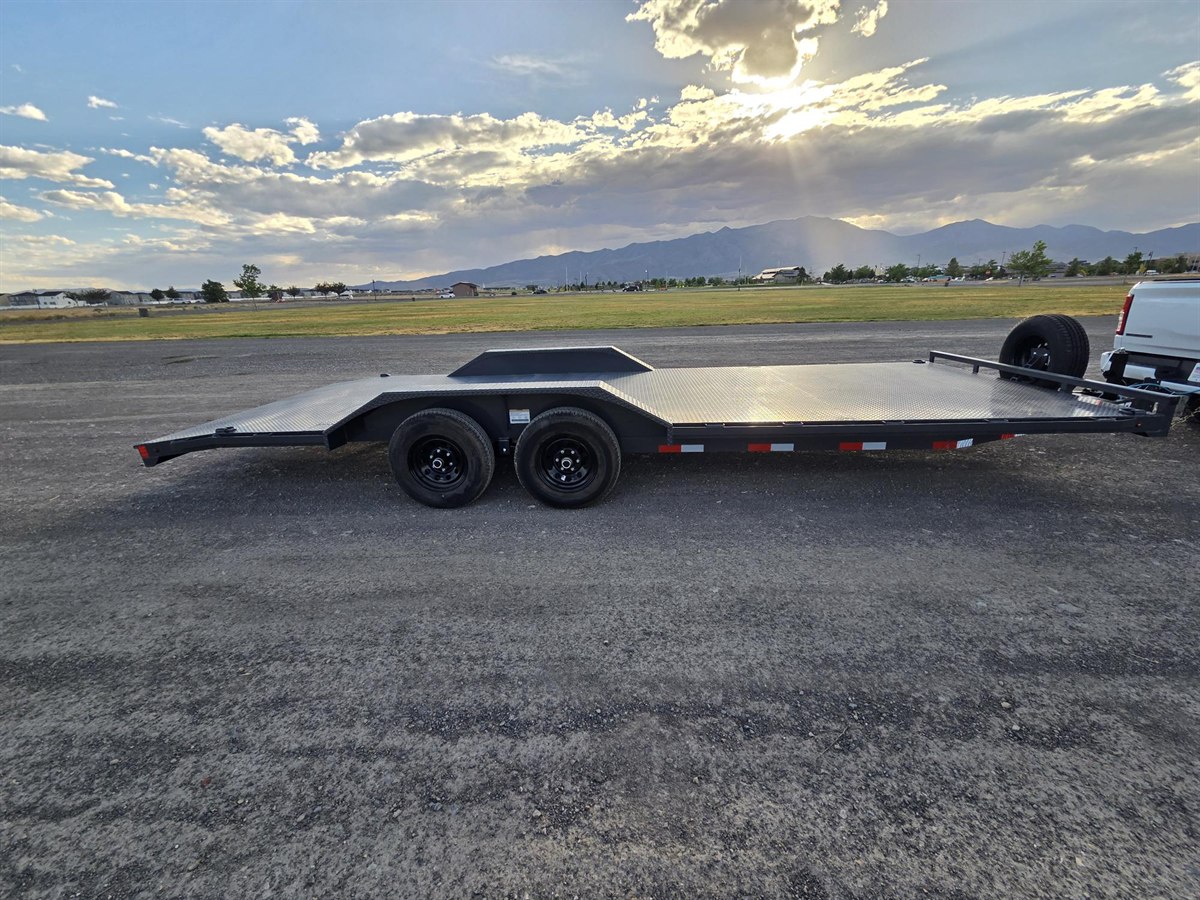
The deck is 22 feet long and 8.5 feet wide, and that 8.5 feet is usable deck the whole way across. The fenders are drive-over, so nothing eats into the middle of the deck the way it does on a standard car trailer.
Payload is right around 7,000 lbs. The trailer weighs about 3,000 lbs empty and the GVWR is 9,990. Everything below is just those two numbers applied to real loads.
The Cybertruck test
The best example I've got is the Tesla Cybertruck we hauled on it, because it pushes on both numbers at the same time.
A Cybertruck runs somewhere between about 6,500 and 6,900 lbs depending on the version. That puts it right up against the roughly 7,000 lb payload — not over it, but close enough that I wouldn't want much else riding on the deck with it. And it's about 86.6 inches wide with the mirrors folded, which is right where a lot of standard car trailers become a problem, because you're threading tires between fender wells that are often narrower than that. On a full-width deck you just line it up and drive on.
Length was never in question. A Cybertruck is about 18 and a half feet, so there was still deck left over on a 22-foot trailer.
Regular cars, trucks, and SUVs
Most vehicles aren't anywhere near the limit. Rough curb weights:
- Midsize sedan: 3,200–3,600 lbs
- Small SUV: 3,800–4,500 lbs
- Midsize to full-size SUV: 4,400–5,400 lbs
- Half-ton pickup: 5,000–6,000 lbs
Those are general ranges, not exact figures. If you're anywhere close to 7,000 lbs, check the sticker in the driver's door jamb of the vehicle you're hauling instead of guessing.
Length is rarely the issue. A full-size crew cab pickup is roughly 19 to 20 feet, so it sits on a 22-foot deck with room at both ends.
Classic and project cars
This is where the drive-over fenders matter most. Lowered cars and wide older cars are exactly what gives a standard car trailer trouble — you're trying to line tires up between two fender wells with a car that might have an inch of ground clearance. Full-width deck and long slide-out ramps means a gentler angle and no threading.
Weight is almost never the problem with classics. Most sixties and seventies muscle cars land in the 3,200–3,800 lb range, which is about half the payload.
Side-by-sides and UTVs
Weight is a non-issue here. A four-seat RZR is somewhere around 2,000 lbs. Length is what you're actually budgeting: a four-seater is roughly 12 feet, a two-seater closer to 10. Two two-seat machines fit on the 22-foot deck without much fuss. A four-seater plus a second machine can work, but measure yours first — I'd rather you measure in your own driveway than figure it out standing in my gravel lot.
It's also just a big flatbed
Plenty of these rentals have nothing to do with vehicles. It's the longest open deck we have, so it takes lumber, pallets, a shed, a compact tractor, or lawn equipment — anything that rides flat and stays under about 7,000 lbs. The deck is diamond-plate steel, so it doesn't need babying.
What you need to pull it
It's a bumper pull with a 2-5/16" ball and a round 7-pin plug. There are electric brakes on both axles, which means your tow vehicle needs a working brake controller. That's the detail that trips people up most often.
Empty, the trailer is about 3,000 lbs. Put a normal car on it and you're somewhere around 6,000 to 7,500 lbs total, which a half-ton with a factory tow package handles fine. Load something like that Cybertruck and you're closer to 9,800 lbs — honestly more than I'd ask a half-ton to do comfortably. That's 3/4-ton territory. If you're not sure where your truck lands, here's how to find your tow rating.
Straps are included
You don't need to go buy tie-downs before you get here. Straps come with the trailer, and there are D-rings along the deck edges so you can secure your load wherever it ends up sitting. If you want a refresher on doing it right, we wrote up how to load and secure a trailer.
Still not sure?
Call or text me at (385) 269-0712 and tell me what you're hauling and what you're pulling it with. I'd rather tell you straight whether it's a fit than have you drive out here and find out it isn't.
The car hauler is $80/day, $480/week, or $1,200/month. Pickup from Eagle Mountain, and you can book it online any time.