"Will my truck handle it?" is the single most common question we get before a rental — and it's a smart one to ask before you hitch up, not after. The good news: matching your vehicle to a trailer is simple once you know two numbers. Here's the 5-minute check.
Step 1: Find Your Vehicle's Towing Capacity
Every vehicle has a maximum trailer weight it's rated to tow. Find yours in one of three places:
- Driver's door jamb sticker — often lists towing and payload info
- Owner's manual — look under "Towing" or "Trailer Weight"
- Online — search your exact year, make, model, and trim plus "towing capacity"
Important: use the number for your specific truck's configuration (engine, drivetrain, axle ratio), not the headline "up to 13,000 lbs" figure from the brochure — that's usually a max-equipped version you probably don't have.
Our Trailers: Empty vs. Loaded Weight
Step 2: Match Capacity to the Loaded Trailer
The number that matters is the loaded weight — the trailer plus whatever you put in it. Your tow rating needs to comfortably exceed that. A good rule: stay under about 80% of your max rating for safe, stress-free towing in Utah's hills and canyons.
What Each Trailer Realistically Needs
- Utility trailer ($40/day): Light and easy. Most mid-size and full-size SUVs with a tow package (4Runner, Tahoe, Highlander, Expedition) and any pickup handle it. Uses a 2" ball and flat-4 connector.
- Enclosed trailer ($95/day): A half-ton pickup (F-150, Silverado 1500, Ram 1500) with a tow package tows it comfortably for a typical household move. Uses a 2-5/16" ball and 7-pin connector.
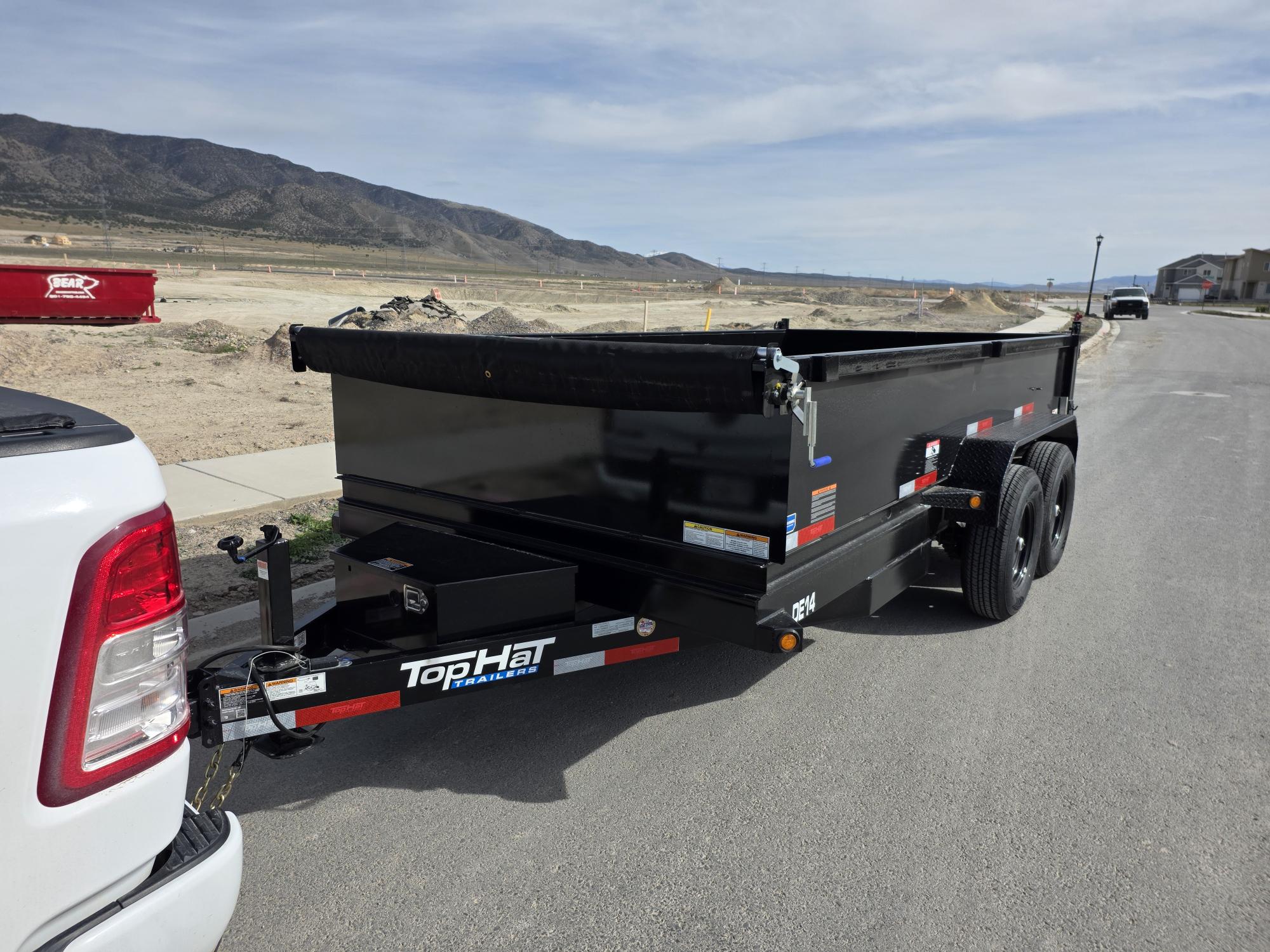
- Dump trailer ($80/day): Fine on a half-ton for lighter loads, but a 3/4-ton truck (F-250, 2500) is the safe call when you're hauling dense material like dirt, gravel, or concrete, which can push it toward 14,000 lbs. Uses a 2-5/16" ball and 7-pin connector.
Don't Forget the Hitch and Wiring
Tow rating isn't the whole story — you also need the right connection:
- Correct ball size: 2" for the utility, 2-5/16" for the enclosed and dump. The wrong ball can let the trailer come loose — this is the most-cited towing violation in Utah.
- Receiver rating: your hitch receiver and ball mount must also be rated for the load, not just the truck.
- Wiring: a 7-pin connector for the dump and enclosed (they have electric brakes), a flat-4 for the utility.
- Brake controller: for the dump and enclosed trailers, your tow vehicle should have a working trailer brake controller.
Still Not Sure? Just Ask
Tell us your vehicle's year, make, model, and trim and what you're hauling, and we'll tell you straight whether it's a good match before you book. We'd rather point you to the right trailer — or tell you a 3/4-ton is the safer bet — than have you show up with a vehicle that can't do the job. Call or text (385) 269-0712, or ask in the chat on any page.